


Page 43 - Fiji Traveller Issue 10
P. 43
Dharamsala


                                    The  serene  home  of  Dalai  Lama


                                  By Saruul Enkhbold

                                    When the opportunity to travel to India arose, I wondered: what could
                                  I possibly experience in just one week? Southern India was out of the
                                  question — the climate would be too similar to that of Fiji, where I was
                                  living. I craved cool temperatures, clean air, and the visage of mountains
                                  — something that would remind me of my homeland, Mongolia. I knew
                                  then: the mountains were calling me for an epic journey.
                                    My adventure began in Nadi, leading me through Singapore and onward
                                  to Delhi. From there, most travellers head directly to Dharamsala via a
                                  short domestic flight to Kangra Airport. But I chose a different path — one
                                  that would allow me to see the landscapes of the Indian state of Himachal
                                  Pradesh change gradually before me.
                                    I boarded an express train from Delhi to Kalka in the Himalayan foothills,
                                  then  hopped  onto  the  historic  “toy  train”  —  a  narrow-gauge  UNESCO
                                  heritage railway that travels slowly up to Shimla. From there, a riveting,
                                  slow drive along winding mountain roads brought me to McLeod Ganj in
                                  the Tibetan district of Dharamsala, nestled amongst the Himalayan peaks.
                                    McLeod  Ganj  is  famed  for  its  monasteries,  meditation  centres,  and
                                  spiritual retreats. Most importantly, it is the home of His Holiness the 14th
                                  Dalai Lama, Tenzin Gyatso, and the centre of the Tibetan government-in-
                                  exile.
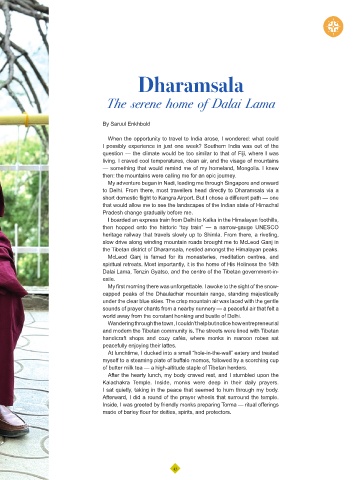
                                    My first morning there was unforgettable. I awoke to the sight of the snow-
                                  capped peaks of the Dhauladhar mountain range, standing majestically
                                  under the clear blue skies. The crisp mountain air was laced with the gentle
                                  sounds of prayer chants from a nearby nunnery — a peaceful air that felt a
                                  world away from the constant honking and bustle of Delhi.
                                    Wandering through the town, I couldn’t help but notice how entrepreneurial
                                  and modern the Tibetan community is. The streets were lined with Tibetan
                                  handicraft  shops  and  cozy  cafés,  where  monks  in  maroon  robes  sat
                                  peacefully enjoying their lattes.
                                    At lunchtime, I ducked into a small “hole-in-the-wall” eatery and treated
                                  myself to a steaming plate of buffalo momos, followed by a scorching cup
                                  of butter milk tea — a high-altitude staple of Tibetan herders.
                                    After the hearty lunch, my body craved rest, and I stumbled upon the
                                  Kalachakra  Temple.  Inside,  monks  were  deep  in  their  daily  prayers.
                                  I sat quietly, taking in the peace that seemed to hum through my body.
                                  Afterward, I did a round of the prayer wheels that surround the temple.
                                  Inside, I was greeted by friendly monks preparing Torma — ritual offerings
                                  made of barley flour for deities, spirits, and protectors.


                                                          43

