


Page 12 - Fiji Traveller Issue 10
P. 12
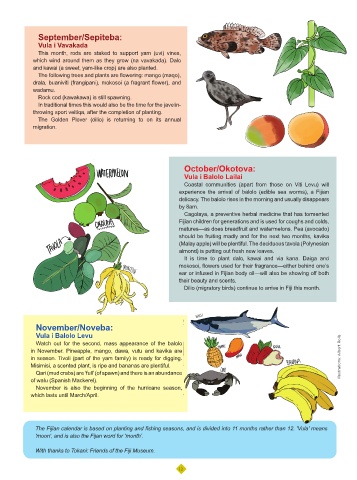
September/Sepiteba:
             Vula i Vavakada
             This  month,  rods  are  staked  to  support  yam  (uvi)  vines,
            which wind around them as they grow (na vavakada). Dalo
            and kawai (a sweet, yam-like crop) are also planted.
             The following trees and plants are flowering: mango (maqo),
            drala, buaniviti (frangipani), mokosoi (a fragrant flower), and
            wadamu.
             Rock cod (kawakawa) is still spawning.
             In traditional times this would also be the time for the javelin-
            throwing sport veitiqa, after the completion of planting.
             The  Golden  Plover  (dilio)  is  returning  to  on  its  annual
            migration.


                                                             October/Okotova:
                                                             Vula i Balolo Lailai
                                                             Coastal communities (apart from those on Viti Levu) will
                                                           experience  the  arrival  of  balolo  (edible  sea  worms),  a  Fijian
                                                           delicacy. The balolo rises in the morning and usually disappears
                                                           by 8am.
                                                             Cagolaya, a preventive herbal medicine that has tormented
                                                           Fijian children for generations and is used for coughs and colds,
                                                           matures —as does breadfruit and watermelons. Pea (avocado)
                                                           should be fruiting madly and for the next two months, kavika
                                                           (Malay apple) will be plentiful. The deciduous tavola (Polynesian
                                                           almond) is putting out fresh new leaves.
                                                             It  is  time  to  plant  dalo,  kawai  and  via  kana.  Daiga  and
                                                           mokosoi, flowers used for their fragrance—either behind one’s
                                                           ear or infused in Fijian body oil—will also be showing off both
                                                           their beauty and scents.
                                                             Dilio (migratory birds) continue to arrive in Fiji this month.


             November/Noveba:
             Vula i Balolo Levu
             Watch  out  for  the  second,  mass  appearance  of  the  balolo
           in  November.  Pineapple,  mango,  dawa,  vutu  and  kavika  are
           in season. Tivoli (part of the yam family) is ready for digging.                                     Illustrations: Albert Rolls
           Misimisi, a scented plant, is ripe and bananas are plentiful.
             Qari (mud crabs) are ‘full’ (of spawn) and there is an abundance
           of walu (Spanish Mackerel).
             November  is  also  the  beginning  of  the  hurricane  season,
           which lasts until March/April.


             The Fijian calendar is based on planting and fishing seasons, and is divided into 11 months rather than 12. 'Vula' means
             'moon', and is also the Fijan word for ‘month’.

             With thanks to Tokani: Friends of the Fiji Museum.


                                                           12

