


Page 27 - Fiji Traveller Issue 10
P. 27
So how did it all start?                          Center, this is a truly a form of women’s economic empowerment.
          “Fiji lags [behind] other Pacific nations in traditional making   “We organise ourselves into tasks but are also able to multitask.
        handicraft.  Most  mother-of-pearl  handicraft  in  Fiji  is  imported.   For example, I can carve something, but I can also assist with
        There was a window for the University of Sunshine Coast USC   sorting jewellery and attending to customers in our shop.
        to effect change,” Claude said.                       “We are also able to budget how much we spend on materials
          While  USC  provided  most  of  the  funding,  Civa  Fiji  Pearls   such as cords for the macramé jewellery, and we have our own
        was involved in finding a site, choosing a village with the best   bank account and M-PAiSA [mobile money transfer service] for
        potential for development, organising the commissioning of the   cashless payments,” Ema says.
        equipment, and finding the first trainees.            Can this story of a simple pearl farm and its community
          “We were the boots on the ground. We provide the farmed   support towards women, set a chain of events for others in the
        shells to the centre. The Ministry of Fisheries is the government   country and region as well? Perhaps, if it gets the right coverage,
        monitoring agent who oversees all these aquaculture projects in   platform and commitment.
        Fiji and there are quite a few of those (spat collecting programs,
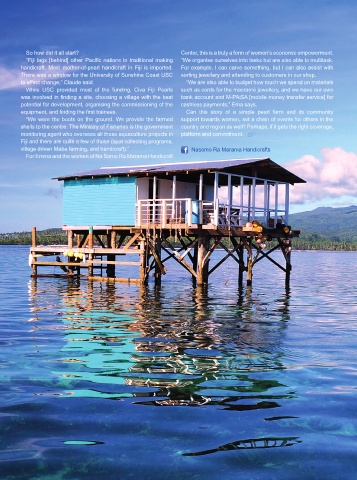
        village driven Mabe farming, and handicraft).”         Nasomo Ra Marama Handicrafts
          For Emma and the women of Na Somo Ra Marama Handicraft


                                                          27

