Bulamaibau reflects on our problems with positivity
By Samantha Magick
In a recent exhibition of many powerful artworks, the contributions of Ulamila Bulamaibau stood out for her delicate balancing of critical commentary and positivity.
‘Kudru’ brought together some of Fiji’s most prominent artists. It’s curator Larry Thomas said the exhibition was “about discontent, and I use that as a metaphor for what I call rumblings, the rumblings not only happening in this country, but also globally.
“When you open the papers, you read the news, there’s always some catastrophe happening around the world, and that’s just the state of the world globally. We can’t change that. We have to just accept it for what it is, but what does it tell us personally? How does it influence us in our thinking? And for me, Kudru is about raising the awareness of what’s happening, but also how to change our perception, or the perception of our society, to be more caring, to be more kinder, to be more loving, compassionate, in spite of the discontent, of the anger, of the horrors that we see.”
Bulaimaibau, an experienced artist and member of the local Blue Wave collective, has been creative since childhood. Participation in this exhibition bought new challenges.
“I wanted to say so many things…things that are happening right now that need to be painted and remembered. [While] I am trying to paint something that is an issue or a problem, at the same time I am trying to get beauty from it.
“I always try and see the beautiful side to things…otherwise the negativity can really weigh us down.”
Bulamaibau’s subject matter is diverse.
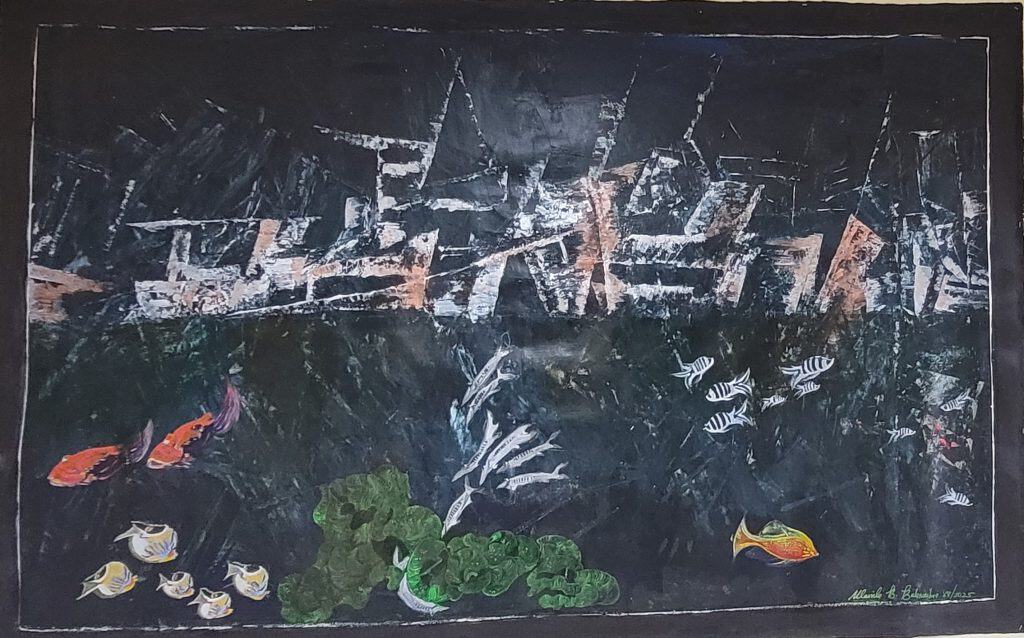
In Wrecks of Draunibota she painted the derelict ships littering the Bay of Islands just outside Suva, but also the vibrant marine life that lies beneath them.
“Whilst we are so bogged down in thinking about the ugliness of things at the surface, we forget that there is life elsewhere and there’s life underneath it. For that painting, that’s the point that I tried to put across, that this is beauty that we need to look after and do our bit in trying to preserve.”
Bilums of Hope depicts two Papua New Guinean women wearing bilums, their traditional woven string bags. It is a companion, and lighter piece to an earlier work, which depicted in dark hues a woman burdened by the problems faced by many in the Pacific; domestic violence, gender-based violence, stigmatisation and more.
In contrast, this painting features brighter colours conveying the same problems and complexity but also hope. It is dense with markings and meanings, and texture.
“ I want people to remember when they come and see that …women are beautiful. They are beautiful. They are strong in their own element, and they do so many things that are often not said… because they are not in the right circles. They are not in the right political circles, or they don’t have a voice in big entities or anything, but they do their bit, and without that bit, things don’t move.
“I hope that viewers come and they see that with all these various markings, that the life of a woman is essential and it must not be forgotten.”
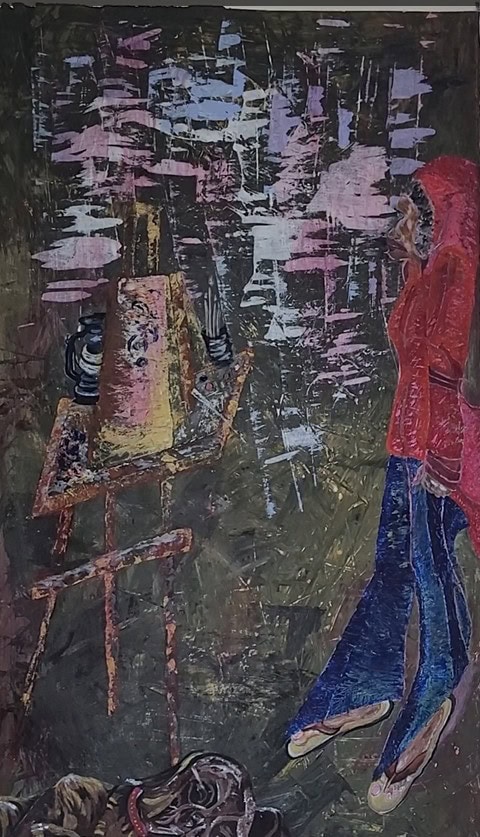
A third painting, Bulamaibau’s self-portrait, provides an insight into the life of an artist. The painting shows her at work at night, with a forest in the background, and her dog Smokey peering out from the frame
“I’ve painted this because I felt that sometimes in my own painting environment, you may not be understood as to why you want to keep away, and sometimes you want to just concentrate on painting, even at odd hours of the night and early in the morning that could easily be misunderstood.”
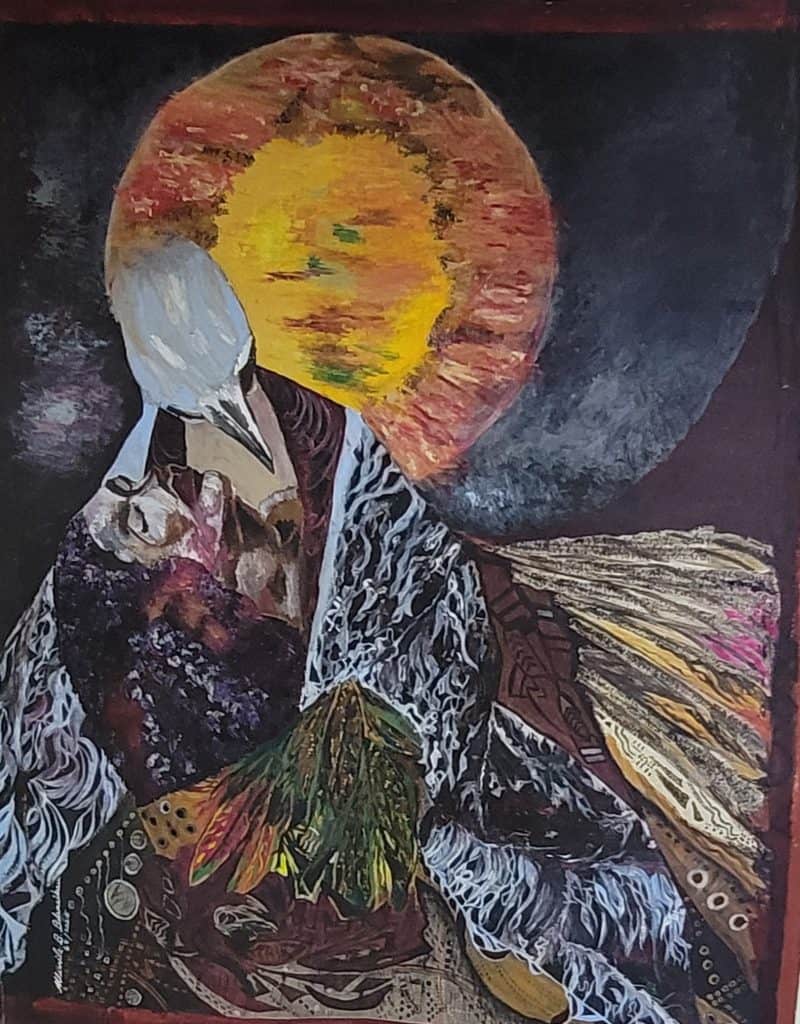
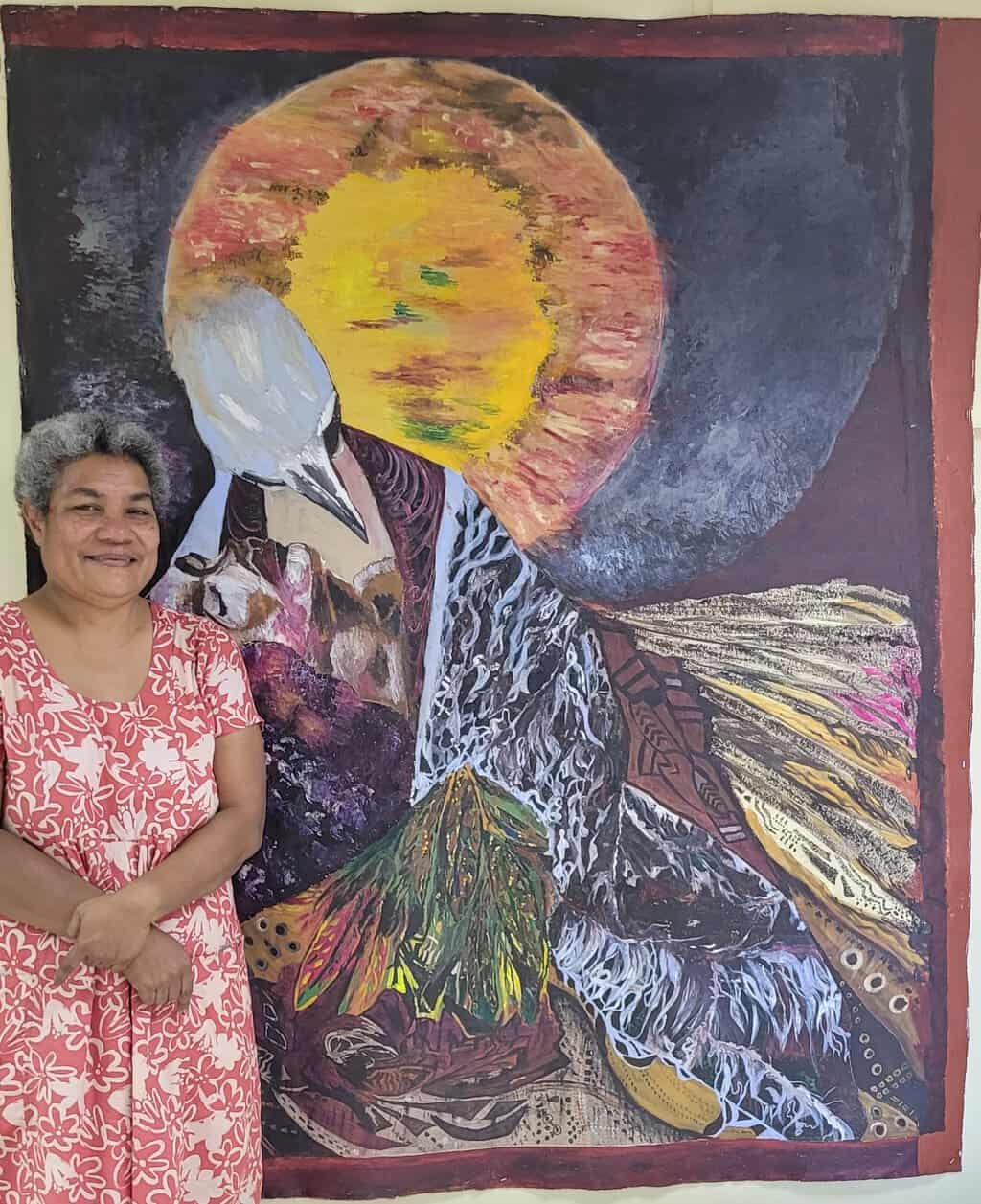
But perhaps the most powerful work Bulamaibau showed in Kudru was titled Who Am I? It is centred on a woman who represents Fijian culture or the iTaukei identity, a bird/totem that is trying to protect her, and a blood moon which symbolises physical and spiritual pain. The central figure of the painting bears tattoos and braids, cultural traditions that have almost been lost.
The work is a reflection, and questioning of culture and tradition, how it has evolved and changed, and how can it be ‘saved’. Describing the work, Bulamaibau asks herself, and the viewer, a number of questions: “Is culture as we understand it real or imagined?” “Can it be saved?” “Are we sure of who and what we are, and what we stand for?” “Where are we headed?” “What are we protecting?”
Bulamaibau says the aim of the painting is to challenge people to question themselves.
“What is it to be called a Fijian? What is your traditional status? Are you thinking of the future. How will it stand for generations to come?”
Like all powerful art, Who am I?, and indeed all the works in ‘Kudru’, asked profound questions of the viewer, the artist and the nation. Bulamaibau’s hope is that the exhibition, or parts of it, could travel to other parts of Fiji to further stimulate discussion and reflection. In the meantime, she continues to hone her art, and work towards future showings.