Spanning the Spectrum
By Ben Wheeler
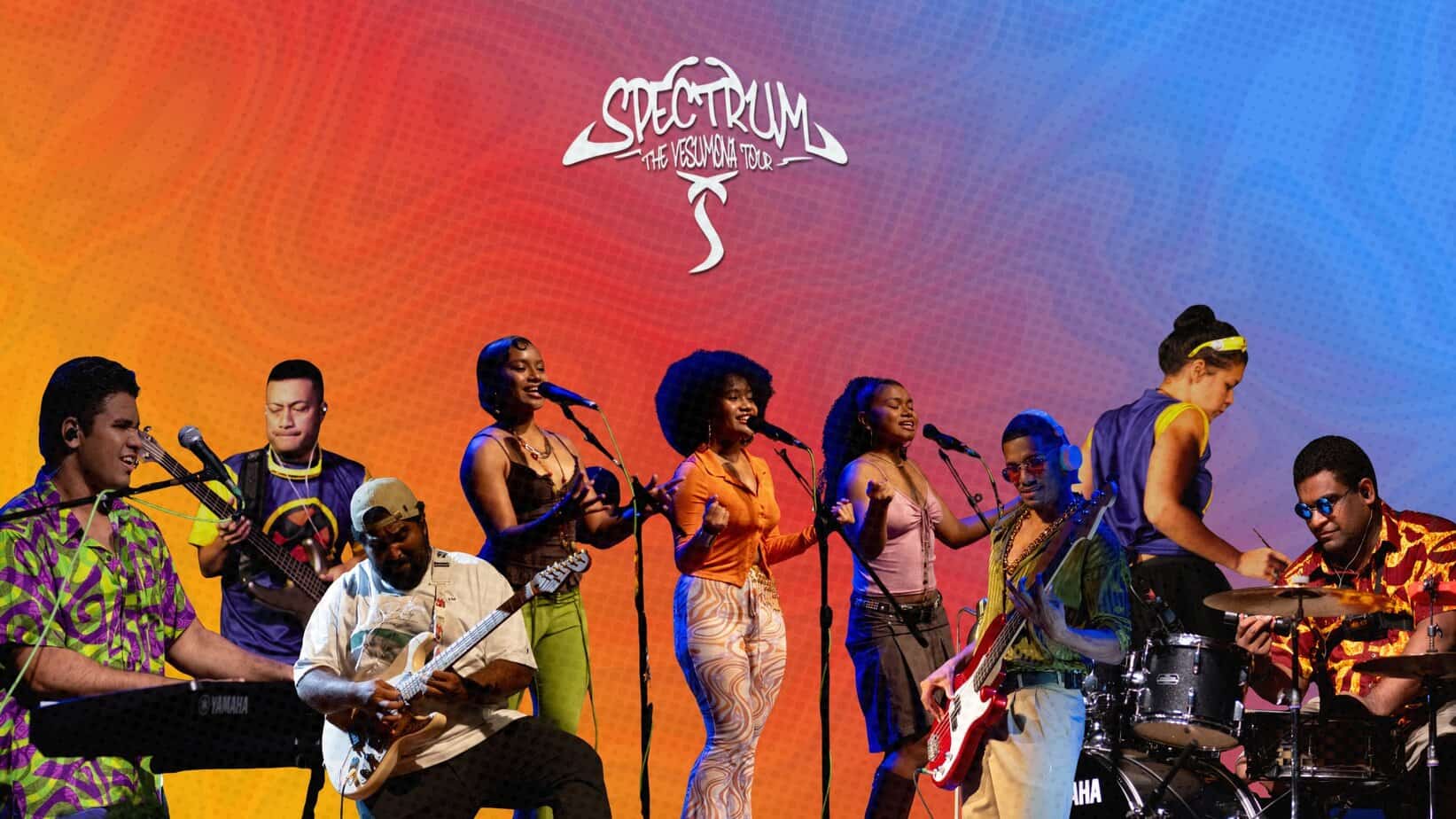
The Fiji Islands is a fertile ground for new movements across the arts sector, and nowhere is this more apparent than in the Spectrum collective, a group of musicians, poets, raconteurs, and visual artists who are making waves here and abroad.
Their work is characterised by an embrace of complexity and nuance. They want to bring people together rather than create division in a time where conflict driven algorithms are ripping the world apart.
Earlier this year they took the Fiji Fringe Festival by storm with their Sema Mai (literally ‘Come Together’) show at the Suva Civic Centre, winning accolades that will see them take their unique creative fusions and soulful stylings to the Adelaide Fringe Festival in early 2026.
Fiji Traveller catches up with Vā members Jasmine and Lia Duanakamakama, Vika and Sevu Tuisawau and William Sanday.
“We started off as V5 but we felt like we were outgrowing that name,” Jasmine explains,“ so Lia came up with the name Vā, which in the Samoan language means ‘the space between.’”
This idea of space is not separation. It is not a void, but a place to draw strength. Vā is about connection and bringing together ideas from different backgrounds from across Oceania. “Even though vā is a Samoan word, the concept is shared throughout the Pacific,” Vika explains. “In Fiji we say veiwakani which means relationships, relational ties, kinship of the vanua, which is the land, community, people.”
“Vā is a great Pacific concept and a cool name that parallels what we want to bring into the music industry,” William adds. “I actually have a Tongan middle name, Fe’ofa’aki, that means love each other, which in Fijian would be veilomani.”
“Wow!” the others chime in apparently learning this for the first time, “that makes so much sense.”
“We are excited to share this space,” Jasmine tells me. “And look forward to expanding our artistry as musicians, as individuals, and connecting with our brothers and sisters in Australia.”
Travelling overseas and playing their own compositions is a huge milestone for Vā and Spectrum, especially coming from a Fijian context in which original music performed in English, rather than covers, is something of a rarity.
“Spectrum is about creative freedom, experimentation, authenticity and joy,” says Anga’aefonu Bain-Vete, who performs live painting on stage during gigs. “It’s about tuning in to each of these as collective resistance tools against oppressive paradigms in the status quo. Creativity is medicine in a whole spectrum of ways.”
“We’d like to encourage people to get to know more about their culture,” Jasmine adds. “Once they know more, they can express who they are as a person more authentically. And that could look very different for each human being.”
“I think there’s a lot of shame,” Vika adds. “I think that shame is normalised when you’re past a certain age and you still don’t know about your culture. I was raised in Vanuatu for a while and I don’t speak iTaukei, but I’m trying.”
I’m struck by how mature these young musicians sound, before Vika drops a stark reminder of their age.
“I think it’s important to know that you can learn about your culture and your roots at any age, whether you’re 18 or 25.”
“Perhaps even older?” I ask with a smile.
“Of course!” they say erupting into fits of laughter. “It’s about connecting, and I don’t think there’s a limit to it.”
Antonia Bhagwan is a writer who co-creates music and lyrics with her brother Francisco and is Spectrum’s “artists’ manager”. She actually says ‘quote unquote’ here, hinting at a rejection of hierarchy with just four words.
“We want to present something that is both broad and deep creatively,” she tells me. “We want to speak truth to power, and that truth is inherently connected to justice because art and music, these are the languages of peace and justice. We’d like to share what being a Pacific Islander means to us, the shared sense of justice and purpose within us.”
Spectrum are refreshingly fearless, entering public spaces and speaking their minds in a way that runs against the grain of traditional Pacific ideas about young people. They represent a growing movement that feels the generations that preceded them, and the world that has been created for them, does not meet their perceptions, wants and needs.
Not that Spectrum don’t have provenance. Their origins run back to 2016, as painter, raconteur and the collective’s emcee Atueta Rabuka (aka Tuets) explains.
“We were going to Leleuvia for a poetry event and 4 Quarters was going to be the band. We jammed under that tamarind tree at Fiji Museum and got a piece sorted with spoken word and music.”
“At the time social media was in its early stages of becoming this behemoth in Fiji, so most of us artists created in isolation and only performed in public events like slams and readings and exhibitions. We created not for curated pieces on social media, us gang created just because we wanted to.”
“Francisco was still a kid at that time and some of these gigs with 4 Quarters, fallah would play,” Tuets remembers. “As they grew, they just continued finding other sparks and things just grew into this collective. We found each other.”
The members of Vā feel similarly blessed to be performing with like-minded souls almost a decade later. Vika extolls the virtues of working with Francisco and 4 Quarters stalwart and local legend Ben Masirewa.
“They’re very professional and we were able to experience that and develop an appreciation for that, and I think that’s what I look forward to now, sharing that space with them.”
There is a rapport across the collective that transcends their connections as Fijians and Pacific Islanders. With three sets of siblings in the line-up, there are strong familial ties that extend to the support network of their wider families, who gently urge them on in their endeavours.
Vika mentions that she is drawing inspiration from conversations with her father, Pita Tuisawau, and would love to incorporate traditional, existentially threatened Pacific practices and instruments like the nose flute into Vā’s music.
As we wrap up the conversation, William admits he’s never heard of the nose flute and is excited to go away and research it. Once again, I am reminded that every member of this collective has a thirst to explore the unknown, pushing themselves in to new creative spaces, fusing musical genres and the traditional and the contemporary into a new and multifaceted expression of the complexity at the heart of Pacific Island culture and identity. Spectrum is ready for the Adelaide Fringe. Let’s hope the Adelaide Fringe is ready for them.